
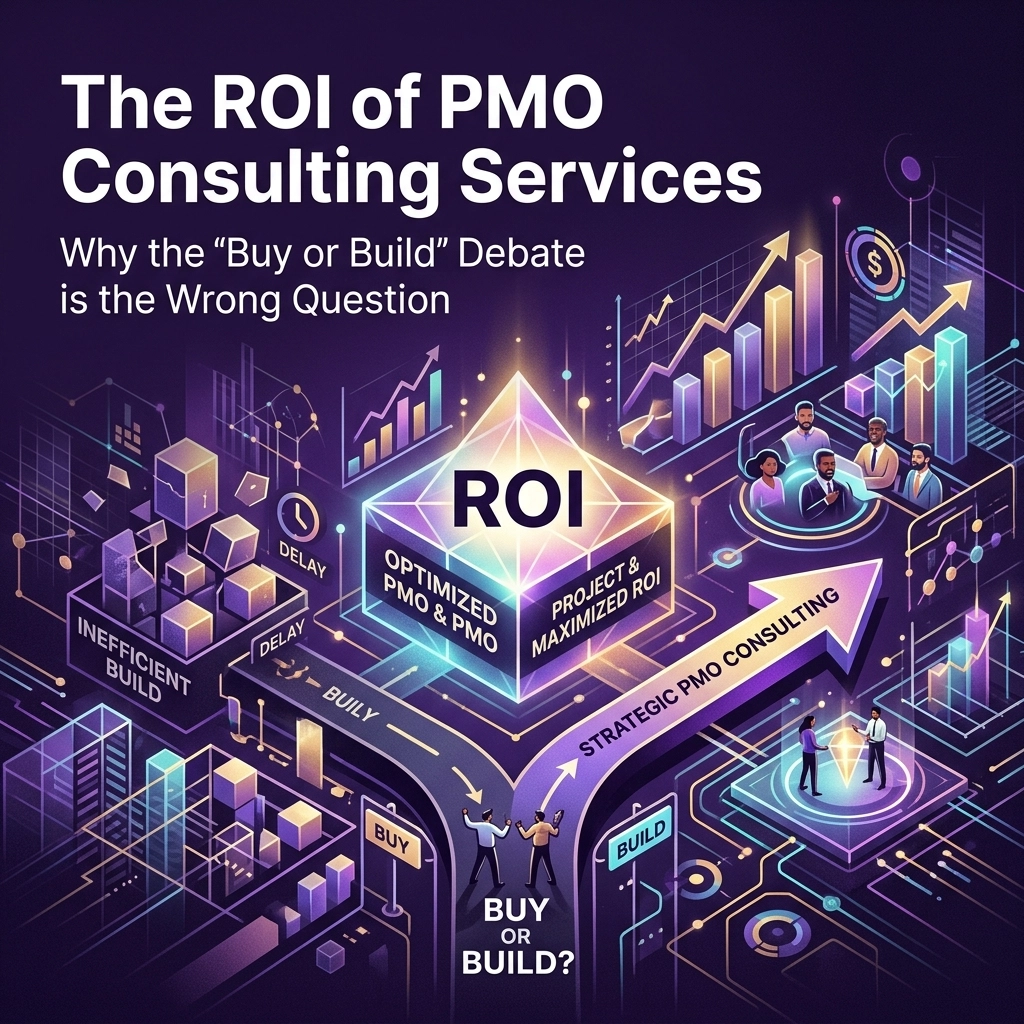
The ROI of PMO Consulting Services: Why the ‘Buy or Build’ Debate is the Wrong Question
I get asked this question all the time: usually over a quick coffee or via a late-night LinkedIn message: “Jeannette, should we just hire our own PMO team, or is it better to bring in external consultants?”
It’s a fair question. On paper, it looks like a simple math problem. You compare the salary and benefits of a full-time hire against the hourly rate of PMO consulting services. But truthfully, focusing on “Buy vs. Build” is like trying to decide whether to buy a cookbook or hire a chef when your kitchen is currently on fire. The debate itself misses the point because it treats project management as a commodity rather than a strategic engine.
In my little world at Lurdez Consulting Group, I’ve seen companies spend millions “building” an internal PMO that looks great on an org chart but fails to move the needle on actual delivery. Conversely, I’ve seen “bought” consulting services that provide a binder full of “wishy-washy” recommendations but no real boots-on-the-ground change.
The real question isn’t about procurement; it’s about Relational Excellence and the speed to value. Today, I want to pull back the curtain on the actual ROI of IT project management consulting and why the best solution is usually a hybrid approach that prioritizes people over processes.
The Digital Transformation Reality Check
Let’s look at the numbers, because even in a casual conversation, the data doesn’t lie. Industry research shows that a well-executed PMO can deliver between 300% to 500% ROI over a three-year period. That’s not just a “nice to have”: that’s the difference between a successful data center transformation and a multi-million dollar write-off.
However, the “Buy or Build” debate usually stalls because of three common myths:
- The Talent Myth: That you can find, hire, and train a “unicorn” PMO lead in six weeks. (Spoiler: You can’t).
- The Continuity Myth: That internal employees provide more stability than consultants. (In reality, the high turnover in tech often makes external partners the only consistent factor).
- The Cost Myth: That consulting is always more expensive. When you factor in the cost of project delays: which typically run 25-35% over budget in unmanaged environments: the “expensive” consultant actually pays for themselves by month six.
The reality check is simple: Digital transformation is moving faster than your HR department can recruit. If you wait to “build,” the opportunity for IT program management excellence might pass you by.
The T.E.A.M. Methodology: The Secret Sauce of ROI
At Lurdez, we don’t just “do” project management. We live by a specific framework that ensures the ROI is baked into every interaction. We call it the T.E.A.M. methodology. When you’re evaluating IT project management consulting, look for these four pillars:
- Tenacious: We don’t back down when a migration gets messy. Whether it’s a data center migration or a software rollout, we stay the course until the job is done.
- Equable: IT projects are stressful. Tensions run high. An equable consultant stays level-headed when everyone else is panicking. We are the “calm in the storm.”
- Analytical: ROI is measured in data. We track the metrics: budget variance, resource utilization, and milestone hits: to ensure you see the financial impact in black and white.
- Magnetic: This is where Relational Excellence comes in. You can have the best plan in the world, but if people don’t want to work with you, the project will fail. We build bridges between the C-suite and the engineering team.

Practical Integration Tips: Making the “Hybrid” Model Work
Instead of choosing between building or buying, most of our successful clients integrate PMO consulting services to jumpstart their internal capabilities. Here’s how you do it without the “us vs. them” mentality:
- Define the “Parking Lot” Items: Use consultants to handle the high-risk, high-complexity projects that your internal team hasn’t tackled before.
- Knowledge Transfer is Mandatory: Don’t just let consultants work in a silo. Pair them with your internal “rising stars.” This is how you “build” while you “buy.”
- Focus on Outcomes, Not Hours: Set clear KPIs for the consulting engagement. If they aren’t improving your network infrastructure project timelines, they aren’t delivering ROI.
- Cultural Alignment: Ensure the external team shares your values. At Lurdez, our people-first approach means we fit into your culture, not disrupt it.
The Leadership Mindset: ROI is a Feeling (And a Fact)
This should go without saying, but truthfully, a lot of CEOs forget that PMO ROI isn’t just about the spreadsheet. It’s about the “peace of mind” factor. Do you have what it takes to step away from the day-to-day firefighting?
I reserve most of my day for high-level strategy because I know my team is handling the “parking lot” of issues. That’s the ROI of leadership. When you hire the right IT project management consulting firm, you aren’t just buying hours; you’re buying the ability to focus on your actual job: growing the company.

Building Your Adaptive PMO
The world doesn’t need another rigid, bureaucratic PMO. We need Adaptive PMOs. These are structures that can pivot when the market shifts or when a new cybersecurity threat emerges.
An adaptive PMO isn’t defined by whether the staff is on a W-2 or a 1099. It’s defined by its ability to deliver value. By bringing in external expertise, you inject fresh perspectives and industry “best practices” that an internal-only team might miss because they’re “too close to the problems.”
8 AI-Augmented PMO Services for 2026
To stay ahead, your PMO needs to embrace the future. Here are 8 ways AI-augmented PMO consulting services are currently driving massive ROI:
- Predictive Resource Planning: Using AI to forecast exactly when you’ll need more hands on deck before the bottleneck happens.
- Automated Status Reporting: Gone are the days of manual PowerPoint updates. AI aggregates real-time data for the C-suite.
- Risk Pattern Recognition: AI identifies “red flags” in project logs that humans might overlook.
- Sentiment Analysis: Measuring the “vibe” of the project team to prevent burnout and turnover.
- Budget Anomaly Detection: Catching a 1% variance before it turns into a 20% disaster.
- AI-Driven Scheduling: Optimizing project timelines across thousands of variables in seconds.
- Automated Documentation: Capturing meeting notes and action items with 99% accuracy.
- Strategic Alignment Scoring: Using AI to ensure every project in the portfolio actually maps back to the CEO’s 2026 goals.

What’s Next?
The ROI of PMO consulting isn’t a “wishy-washy” concept: it’s a measurable, strategic advantage that allows you to scale faster than the competition. Stop worrying about the “Buy or Build” debate and start focusing on who can deliver the T.E.A.M. methodology to your organization today.
I’m so glad we could chat about this today! If you’re wondering how your current setup stacks up, I highly recommend checking out our Personality Test to see how your leadership style influences your project outcomes.
Next week, we’re diving into a hot topic: “7 Mistakes You’re Making with AI Integration.” Trust me, you don’t want to miss that one: it’s going to be stellar!
Stay tenacious,
Jeannette Lurdez Collazo
CEO, Lurdez Consulting Group