
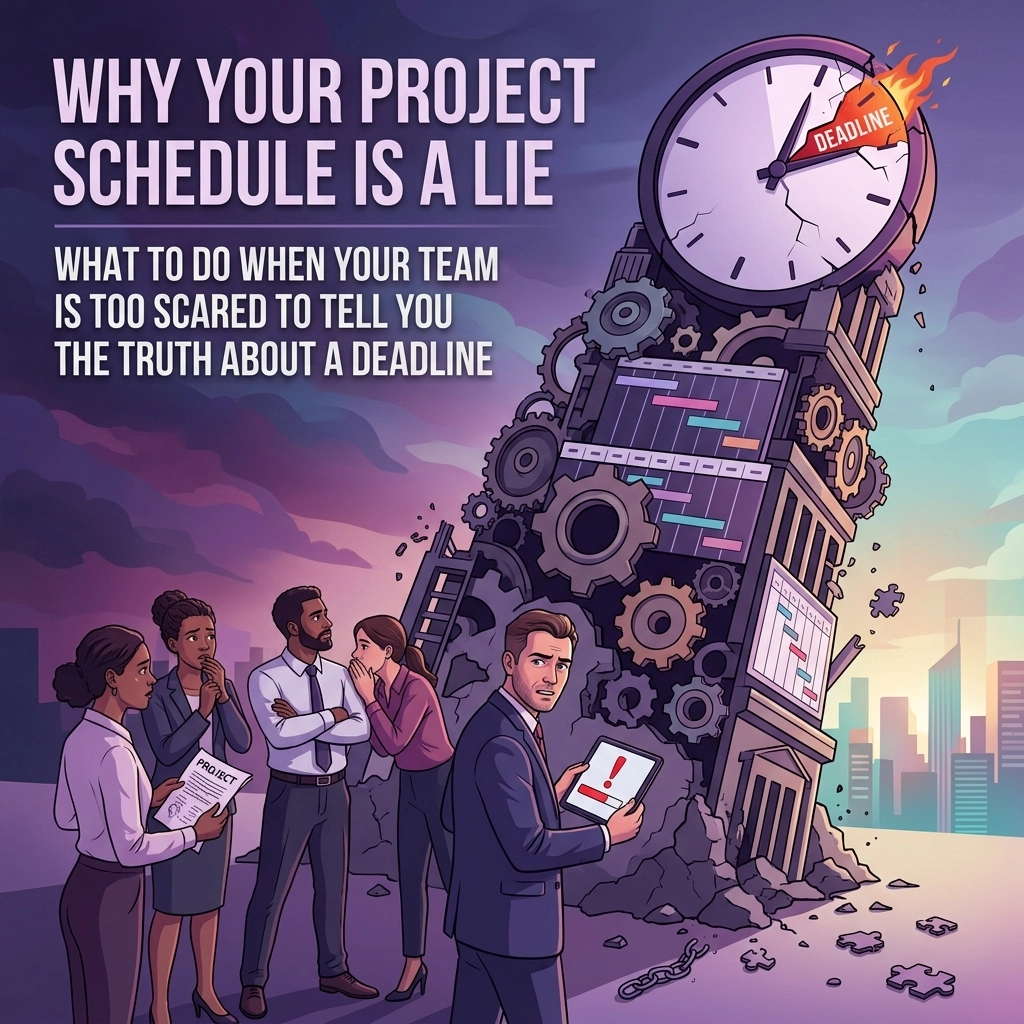
Why Your Project Schedule is a Lie: What to do when your team is too scared to tell you the truth about a deadline
Let’s be honest for a second, how many times have you looked at a project schedule, saw a sea of green “on track” bars, and felt in your gut that something was dead wrong? I’ve been in this industry for a long time, and if there’s one thing I’ve learned, it’s that a Gantt chart is often less of a roadmap and more of a work of fiction.
I see it all the time. A project is “90% complete” for three months straight. Then, suddenly, two weeks before the big launch, the “Red” lights start flashing, and everyone is scrambling like it’s a fire drill. It’s not that the team is lazy; it’s that they were too scared to tell you the truth when it mattered.
I get emails about everything, from minor server hiccups to major budget shifts, but the hardest thing to get out of a team is a “no” to a deadline. We’ve created a culture in IT where missing a date feels like a moral failing. So, instead of being honest, teams get wishy-washy. They pray for a miracle. They hope another department messes up first so they can hide their delay behind someone else’s.
It’s time to stop the nonsense. If your project schedule is a lie, you can’t lead effectively. Let’s talk about why this happens and how we, as leaders, can fix the communication gap before the whole thing goes off the rails.
The Digital Transformation Reality Check
In my little world at Lurdez Consulting Group, we deal with massive digital transformations. These aren’t just “installing some software” jobs; they are fundamental shifts in how a company operates. When you’re dealing with something that complex, a static schedule is your worst enemy.
The reality check is this: most project schedules fail because they are built on “best-case scenarios” and management pressure rather than actual data. I call it the “Approval Bermuda Triangle.” A manager wants a project done by October because that’s when the fiscal year ends or because they promised a stakeholder a “win.” They work backward from that date, squeezing the IT team into a timeline that ignores reality.
When you coerce a developer or an engineer into a timetable they didn’t create, you aren’t getting a commitment; you’re getting a polite lie. They know the specs are poor. They know the vendors will take twelve weeks instead of eight. But they also know that saying “that’s impossible” in a high-pressure meeting is a great way to get a target on their back. So, they nod, they smile, and they go back to their desks knowing the schedule is a lie.
The T.E.A.M. Methodology: Reclaiming the Truth
To fix a lying schedule, we have to fix the relationship between the leader and the team. This is where our T.E.A.M. methodology, Tenacious, Equable, Analytical, and Magnetic, comes into play. It’s not just about managing tasks; it’s about managing the human element of IT program and project management.
- Tenacious: You have to be tenacious about seeking the truth. This means not just accepting a “we’re on track” status. It means digging deeper, asking the hard questions, and being persistent until you see the evidence.
- Equable: This is the big one. If you blow a fuse every time someone gives you bad news, guess what? You’re never going to get the truth again. Being equable means staying calm when the schedule slips. It means creating a safe space where a “Red” status is viewed as a problem to solve, not a person to blame.
- Analytical: Use the data, not just the vibes. If your analytical tools say a task usually takes three weeks but your team says they can do it in three days, your “Analytical” side should be sounding the alarm. Look at historical performance, not just optimistic projections.
- Magnetic: As a leader, you need to be magnetic enough to draw people into a collaborative circle. When people feel connected to you and the vision, they want the project to succeed as much as you do. They’ll tell you the truth because they don’t want to let you, or the team, down.
Practical Integration Tips: How to Spot the Lie
So, how do you practically stop the lying? It starts with how you run your meetings and how you structure your reporting.
First, kill the “parking lot” for bad news. If someone has a concern about a deadline, that should be the first item on the agenda, not the last thing squeezed into the final five minutes.
Second, stop asking “Are we on time?” and start asking “What is the biggest risk to our deadline today?” This shifts the focus from a “yes/no” trap to a collaborative problem-solving session.
Third, look for the “Phantom Float.” This is that extra time people build into their estimates because they don’t trust the process. If you find your team is consistently finishing early or (more likely) using every second of a padded schedule to deliver at the last minute, your planning process is broken.
The Leadership Mindset: Psychological Safety
Truthfully, if your team is scared to tell you a deadline is slipping, that’s a leadership problem, not a technical one. We have to foster what I call “Relational Excellence.”
I have some people in my life who are terrified of conflict. In a business setting, those people will hide a project delay until it’s a catastrophe because they’d rather deal with a massive explosion later than a small uncomfortable conversation today. As a leader, you have to realize that your personality might be intimidating.
Are you the kind of leader who celebrates the “hero” who stays up all night to fix a mess that shouldn’t have happened? Or are you the leader who celebrates the person who spoke up three weeks ago and said, “Hey, this scope is creeping, and we won’t make the date”? We need more of the latter.
Building Your Adaptive PMO
At Lurdez Consulting Group, we believe in the Adaptive PMO. A traditional Project Management Office is often a rigid entity that polices schedules. An Adaptive PMO, however, is a living, breathing part of the organization that adjusts to reality in real-time.
An Adaptive PMO doesn’t just record the lie; it challenges it. It uses cross-functional data to see if the “Engineering” schedule aligns with the “Procurement” reality. It bridges the gap between leadership and the technical teams, ensuring that communication flows both ways.
8 AI-Augmented PMO Services to Keep Your Schedule Honest
We are in a new era of project management where we don’t have to rely solely on human intuition to spot a lie. AI can be a powerful truth-teller. Here are 8 ways an AI-augmented PMO can keep your projects on track:
- Predictive Risk Scoring: AI can analyze thousands of data points from past projects to tell you the statistical likelihood of hitting your current deadline.
- Sentiment Analysis in Comms: Believe it or not, AI can analyze the tone of team Slack messages or emails to detect “project stress” before it shows up on a report.
- Automated Scope Creep Detection: AI can flag when the number of requirements is growing while the deadline remains static.
- Resource Bottleneck Forecasting: Identifying who is over-allocated before they burn out and stop reporting the truth.
- Historical Estimation Benchmarking: Comparing current team estimates against what has actually happened in the past to identify “optimism bias.”
- Real-time Vendor Tracking: Integrating external lead times directly into your schedule so you aren’t guessing when hardware will arrive.
- Dynamic Float Management: Automatically adjusting buffers based on the current velocity of the team.
- Automated Status Sanitization: AI can help “translate” technical hurdles into business-ready status reports that don’t lose the critical “warning” details in the process.
What’s Next: The Introvert’s Advantage
I hope this gives you some food for thought. Stop looking at those Gantt charts as gospel and start looking at them as a conversation starter. If you want to dive deeper into how we handle the human side of tech, check out our testimonials to see how we’ve helped other leaders navigate these messy waters.
Next week, we’re going to flip the script. We often think the loudest person in the room is the best leader, but I’m going to show you why your “quietest” IT leaders are actually your secret weapon for ROI. We’re calling it The Introvert’s Advantage.
Until then, stay tenacious, stay equable, and please: stop believing the lies on your project schedule!