
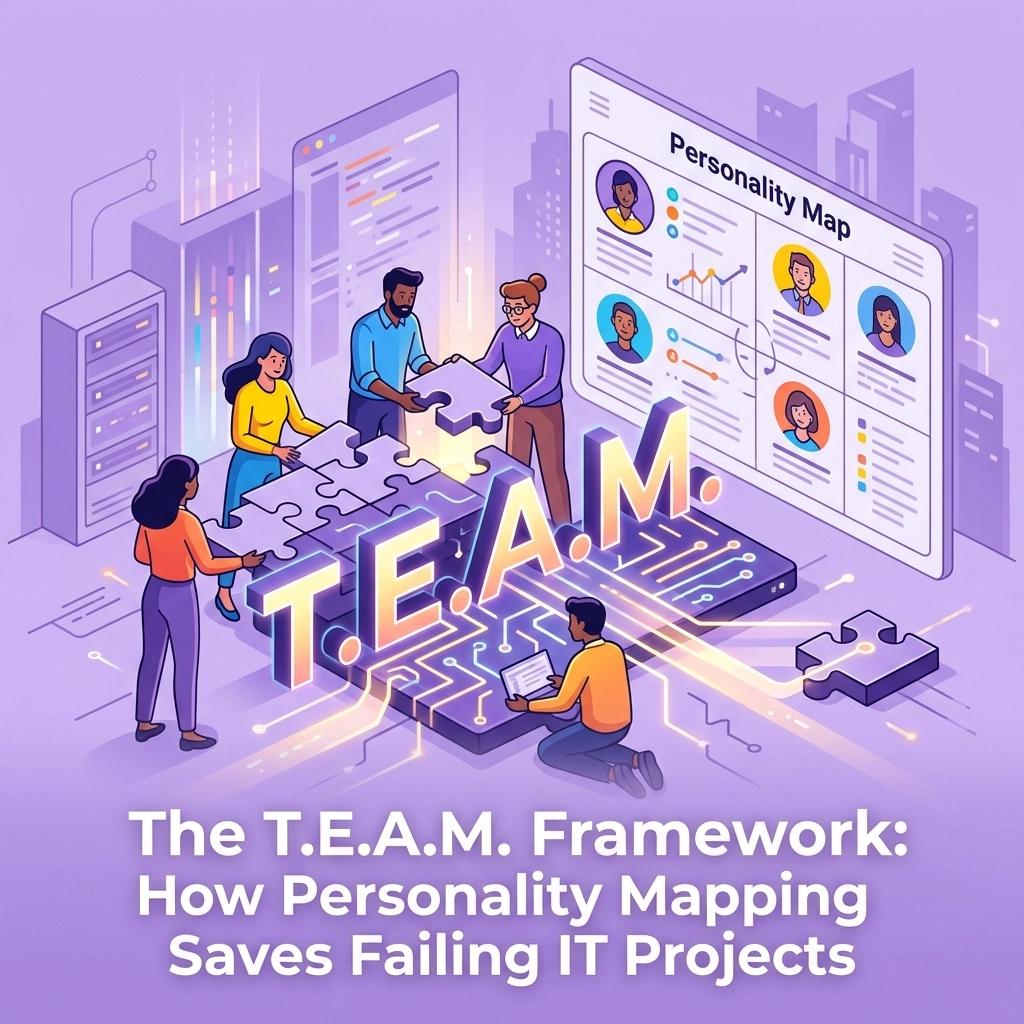
The T.E.A.M. Framework: How Personality Mapping Saves Failing IT Projects
Category: Blog > English
I get emails about everything: from technical debt that’s spiraling out of control to stakeholders who change their minds more often than they change their socks. But if I’m being honest, most of the “failing” projects I see across my desk at Lurdez Consulting Group aren’t dying because of a bad API or a slow database. They are dying because of people.
I’ve spent a lot of time in my little world thinking about why brilliant engineers and seasoned project managers often hit a brick wall. This should go without saying, but truthfully, we often forget that IT projects are human endeavors wrapped in code. When the human element isn’t aligned, the project isn’t just delayed; it’s doomed.
That’s exactly why I wrote my book, T.E.A.M.: The IT Project Manager’s Secret Decoder for Increasing Relational Excellence. I wanted to provide a structured way to look at the invisible forces: personalities: that dictate whether a team thrives or burns out. In a nutshell, we use a proprietary methodology we call the T.E.A.M. framework to map out the “who” before we ever worry about the “how.”

The Digital Transformation Reality Check
Let’s have a quick reality check: Digital transformation is messy. You can have the most advanced IT program and project management tools in the world, but if your lead architect is a “perfectionist” clashing with a “move fast and break things” developer, you’re going to have friction.
We see this every day. Constant miscommunication between dev and product teams, avoided conflicts that turn into full-on relationship breakdowns, and the wrong people placed in “firefighter” roles. It’s wishy-washy leadership to just hope people will “get along.” You need a decoder ring. You need to understand that personality mapping is the missing link in modern IT consulting.
The T.E.A.M. Methodology: Your Secret Decoder
At Lurdez Consulting Group, we don’t just look at resumes; we look at traits. Our T.E.A.M. framework categorizes professionals into four distinct but complementary archetypes: Tenacious, Equable, Analytical, and Magnetic.
1. Tenacious (The Drivers)
These are your goal-oriented, high-energy individuals. They are the ones who will push through a weekend to meet a deadline. They are assertive, decisive, and sometimes a little blunt. If a project is stalled, you want a Tenacious personality to grab the reins. However, without balance, they can run over the feelings of others in their pursuit of the “win.”
2. Equable (The Stabilizers)
I have some Equables in my life, and thank goodness for them! These individuals are the “glue.” They are steady, supportive, and excel at maintaining harmony. In the high-stress environment of network infrastructure or data center migration, they are the calm in the storm. They listen more than they speak, ensuring everyone feels heard.
3. Analytical (The Detectives)
The Analyticals are the ones reading the fine print of the documentation. They are precise, logical, and data-driven. They don’t make guesses; they make informed decisions. When you’re dealing with cybersecurity, you want an Analytical lead who won’t miss a single vulnerability. Their challenge? Sometimes they get stuck in “analysis paralysis.”
4. Magnetic (The Influencers)
Magnetic personalities bring the “sunny side up” energy to the office. They are visionaries and great communicators. They are stellar at getting stakeholders on board with a new data center transformation. They focus on the big picture and the “why,” though they might need help staying grounded in the day-to-day details.

Practical Integration Tips
Understanding the theory is great, but how do you actually use this to save a project? Here is a simple way to start integrating the T.E.A.M. framework this month:
Step 1: Make the Invisible Visible
Have your team take our personality test. Don’t just file the results away. Discuss them. Ask each person to share how they prefer to receive feedback. Does your Tenacious lead want a direct “this is wrong,” or does your Equable developer need a softer, relationship-first approach?
Step 2: Align Roles to Traits
Look at your current project staffing. Are you asking an Analytical person to lead a high-stakes, highly social stakeholder discovery session? That’s a recipe for burnout. Try to align tasks with natural rhythms. Use your Magnetic types for influence and your Tenacious types for unblocking bottlenecks.
Step 3: Monitor and Tune
Personality isn’t static, and neither is team dynamic. In your weekly retrospectives, ask: “Where did our style differences help or hurt us this week?” This keeps the methodology alive rather than just being a one-off workshop.
The Leadership Mindset
As a leader, you must admit that you can’t change people’s core personalities: and you shouldn’t want to! The goal is maturation, not “fixing.” A mature Tenacious leader learns to dial down the intensity when the team is stressed. A mature Equable team member learns to surface conflict early rather than letting it fester.
I reserve most of my day for mentoring because I believe that time, experience, and education can always help someone move from a “raw” trait to a “mature” strength. Where do you excel? Where do you struggle? Being honest about your own T.E.A.M. profile is the first step to becoming a leader people actually want to follow.

Building Your Adaptive PMO
In today’s market, a rigid Project Management Office (PMO) is a dead PMO. You need an Adaptive PMO that understands how to shift resources based on both skill and personality. When we provide IT engineering services, we don’t just throw bodies at a problem. We build a balanced squad.
A balanced squad usually includes:
- A Magnetic visionary to keep the goal in sight.
- An Analytical expert to ensure technical integrity.
- A Tenacious driver to maintain momentum.
- An Equable coordinator to keep the peace.
If you are missing one of these, you’ll feel the gap. Too many Tenacious types? You’ll have a power struggle. Too many Analyticals? You’ll never ship.
8 AI-Augmented PMO Services
While we focus on the human side, we can’t ignore that AI is changing the game for leadership. Here are 8 ways AI-augmented services can support your T.E.A.M. framework:
- Automated Skill & Personality Mapping: Using AI to suggest the best team composition for a specific project based on past performance data.
- Sentiment Analysis in Comms: AI tools that flag when team communication is becoming overly aggressive or “toxic,” allowing for early intervention.
- Conflict Prediction: Analyzing patterns in meeting transcripts to predict where a Tenacious/Analytical clash might occur.
- Resource Load Balancing: AI that detects when an Equable “glue” person is taking on too much “emotional labor” and is at risk of burnout.
- Predictive Risk Assessment: Moving beyond spreadsheets to use machine learning to identify project risks before they become issues.
- Virtual Coaching Bots: Providing “just-in-time” communication tips based on the personality of the person you are about to email.
- Skill Gap Analysis: AI that identifies which T.E.A.M. trait is missing from your PMO and suggests careers profiles to hire for.
- Knowledge Management: AI-powered wikis that translate complex technical data (Analytical) into easy-to-understand summaries (Magnetic).

What’s Next?
If your IT project is wobbling, don’t just look at the code. Look at the people. Are they in the right seats? Do they have a shared language for their differences? Remember, a “people problem” is usually just an “alignment problem.”
Next week, we are going to dive deeper into the specific world of Cybersecurity Culture: Training Your Team to be the First Line of Defense. It’s going to be a stellar session on how to turn even your most “Magnetic” (and potentially click-happy) employees into security assets.
If you’re ready to stop the project bleeding and start building a high-performing team, contact us today. Let’s get your T.E.A.M. aligned.