
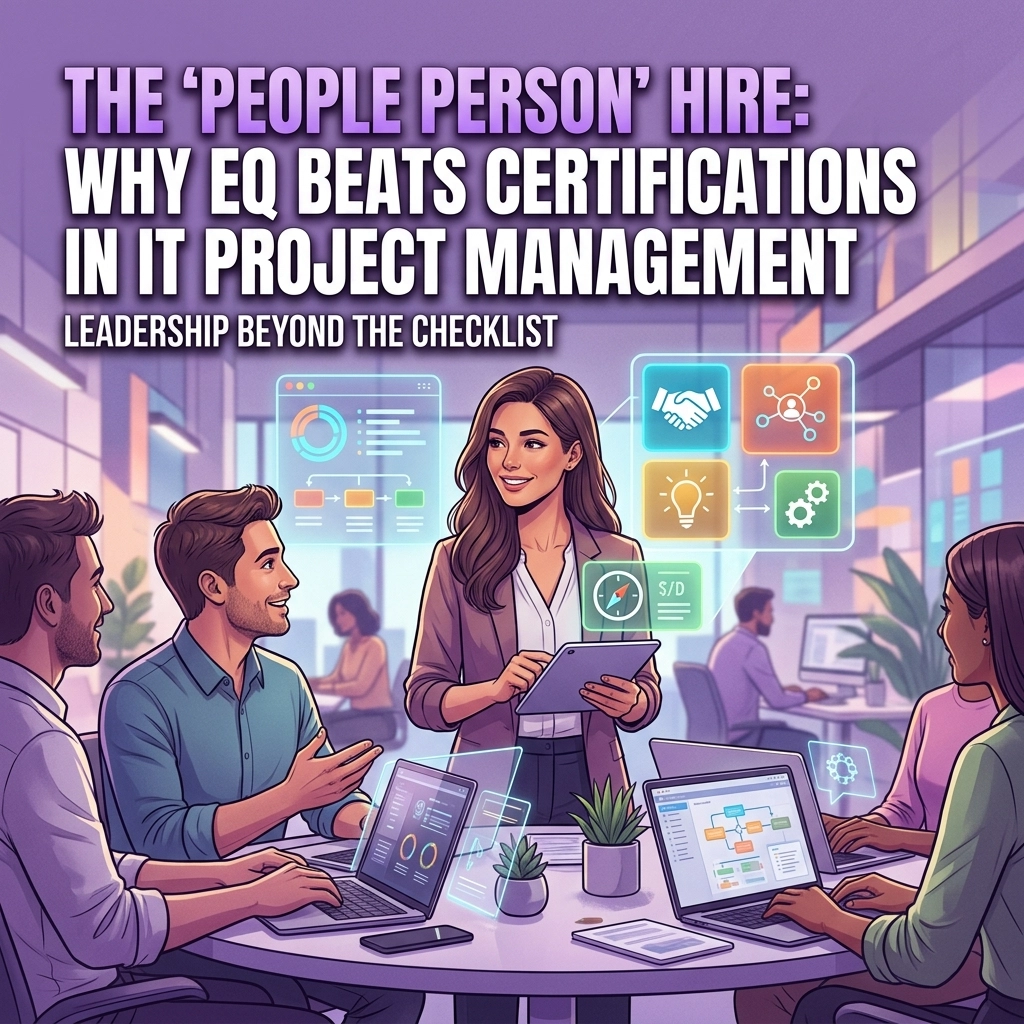
The ‘People Person’ Hire: Why EQ Beats Certifications in IT Project Management
Category: Blog > English
I’ve sat across the table from hundreds of IT Project Managers over the years. Many of them come armed with a “alphabet soup” of credentials following their names: PMP, PRINCE2, ITIL, CSM: you name it, they’ve earned it. And don’t get me wrong, those certifications are great. They show dedication, a certain level of knowledge, and they certainly look impressive on a LinkedIn profile.
But here’s a little secret from my world: I’ve seen projects with “perfectly certified” managers crumble into a heap of missed deadlines and frustrated stakeholders. Conversely, I’ve seen managers with half the credentials: but double the Emotional Intelligence (EQ): steer a sinking ship right back into sunny waters.
In the fast-paced, often high-stress environment of IT program and project management, we tend to get obsessed with technical prowess. We want the person who knows every niche feature of Jira or who can recite the PMBOK guide from memory. But when the “you-know-what” hits the fan, it’s not the certification that fixes the problem. It’s the person who knows how to talk to a stressed developer, how to manage a nervous CEO, and how to keep a team motivated when the budget gets slashed.
Today, I want to talk about why the “people person” hire is actually your most strategic move and how focusing on “relational excellence” can transform your IT outcomes.
The Digital Transformation Reality Check
We live in an era of constant digital transformation. Companies are migrating to the cloud, overhauling their cybersecurity, and trying to make sense of AI: all at once. It’s a lot. If you look at our services, you’ll see how complex these technical shifts can be. But here’s the reality check: digital transformation isn’t actually about the “digital” part. It’s about the “transformation” part, and transformation is a human experience.
I often say that servers don’t have bad days, but the people running them do. You can have the most robust network infrastructure in the world, but if your team isn’t communicating, that infrastructure is a house of cards.
The biggest bottleneck in most IT projects isn’t a lack of technical skill; it’s a breakdown in human connection. It’s the “wishy-washy” communication that leads to scope creep. It’s the lack of empathy that leads to burnout. Relational excellence is the lubricant that keeps the gears of technical projects turning. Without it, everything just grinds to a halt. When we hire for EQ, we are hiring for the ability to navigate the messy, unpredictable, and often emotional landscape of human collaboration.

The T.E.A.M. Methodology
At Lurdez Consulting Group, we don’t just wing it when it comes to the human element. We use a very specific framework that I’ve detailed in our team book. We call it the T.E.A.M. methodology. When we talk about finding a project manager with high EQ, we are looking for these four traits:
- Tenacious: Technical projects are hard. Things go wrong. A high-EQ leader doesn’t just check a box saying a task is late; they are tenacious in finding out why and helping the team overcome the hurdle without demoralizing them. They have the grit to see things through when the “new car smell” of a project wears off.
- Equable: This is a big one. In the middle of a data center migration gone wrong at 2:00 AM, you don’t need someone who panics. You need someone who is equable: steady, calm, and composed. Their emotional stability becomes the team’s anchor.
- Analytical: EQ isn’t just about “feelings.” A great PM is analytical about human behavior. they observe patterns in the team, recognize when someone is disengaged, and use that data to adjust their leadership style. They analyze the “people data” just as much as the project data.
- Magnetic: People want to work for them. A magnetic leader doesn’t have to rely on their title to get things done. They lead through influence and trust. They build a culture where people want to give their best, not because they’re afraid of a PIP, but because they believe in the mission and the person leading it.
Practical Integration Tips: How to Spot EQ in the Wild
So, how do you actually find these people? If you’re looking at a stack of resumes, they all start to look the same. Here are a few ways to spot relational excellence during the hiring process:
- Ask about the “Gaps”: Instead of asking about their biggest project, ask about their biggest failure. Pay attention to how they talk about it. Do they blame the “incompetent” dev team? Or do they take ownership and explain how they managed the fallout with stakeholders?
- The “Vibe” Check: I know, it sounds unscientific, but it matters. How do they make the interviewer feel? Are they listening actively, or are they just waiting for their turn to speak? A person with high EQ makes you feel heard.
- The Personality Test: We actually offer a personality test on our site because we believe understanding a person’s core wiring is essential for project success. Use these tools to see if their natural tendencies align with the T.E.A.M. traits.
- Scenario-Based Questions: Give them a “people problem,” not a technical one. “Your lead engineer and your QA manager are at each other’s throats. It’s delaying the sprint. What do you do?” Their answer will tell you everything you need to know about their EQ.

The Leadership Mindset
The shift from being a “task manager” to a “leader” requires a total mindset overhaul. Task managers live in spreadsheets; leaders live in the “white space” between the cells.
I’ve learned in my own journey: and you can read more about my perspective on our about us page: that leadership is about service. It’s about clearing the path so your team can run. When a PM prioritizes EQ, they aren’t just “being nice.” They are being strategic. They are building social capital.
That social capital is what they spend when they have to ask the team to work a weekend or when they have to deliver bad news to the C-suite. If you haven’t built those relationships, you have an empty bank account when things get tough. A leadership mindset recognizes that the “people work” is the work.
Building Your Adaptive PMO
In a traditional PMO (Project Management Office), the focus is often on compliance and governance. “Did you fill out the change request form? Is the status report in by Friday?” While those things matter, an Adaptive PMO focuses on outcomes and agility.
An Adaptive PMO is fueled by EQ. It’s an environment where feedback is a gift, not a threat. By hiring for relational excellence, you create a PMO that can pivot when the market changes. If your PMs are “Magnetic” and “Equable,” they can lead their teams through a sudden shift in strategy without losing momentum.
We’ve seen this time and again in our testimonials. Clients don’t usually rave about our gantt charts (though they are pretty stellar!). They rave about how we handled the stress, how we brought their teams together, and how we made a complex process feel manageable.

8 AI-Augmented PMO Services
Now, I know what you’re thinking: “Jeannette, this sounds like a lot of ‘soft’ work. How do we find time for all this human connection when there are a thousand tasks to track?”
That is where technology: specifically AI: comes in. We use AI to handle the “grunt work” so our PMs can focus on the “human work.” Here are 8 ways an AI-augmented PMO can free up your “People People” to do what they do best:
- Automated Status Reporting: AI can pull data from various tools to draft status reports, saving hours of manual entry.
- Predictive Risk Analysis: Using historical data to flag potential bottlenecks before they happen, allowing the PM to address the human side of the risk early.
- Resource Optimization: Algorithms that suggest the best team members for a task based on skill and availability, taking the guesswork out of capacity planning.
- Meeting Transcription & Summarization: AI tools that record meetings and pull out action items so the PM can actually engage in the conversation instead of frantic note-taking.
- Sentiment Analysis: Tools that “read” the tone of project communications (emails, Slack) to alert the PM if team morale seems to be dipping.
- Schedule Compression Modeling: AI can run “what if” scenarios for project schedules in seconds, providing the PM with data-backed options to present to stakeholders.
- Automated Documentation: Keeping the technical wiki up to date using AI assistants, ensuring the “Analytical” part of T.E.A.M. is always fed with fresh data.
- Budget Forecasting: Real-time tracking and projection of spend, so the PM can have “Equable” conversations with the finance department.
By offloading these tasks to AI, we allow our project managers to spend their day where it matters most: with their people.
What’s Next
I hope this gives you a new perspective on your next hire. While that PMP certification is a fantastic baseline, don’t let it be the only thing you look for. Look for the person who can read the room. Look for the person who remains “Equable” when the server room is on fire. Look for the “People Person.”
In our next post, we’re going to dive deeper into the “Magnetic” side of the T.E.A.M. methodology. We’ll explore how to build a personal brand within your organization that makes people want to be on your project team.
Until then, remember: technology is just the tool. People are the power. If you need help finding the right balance for your IT projects, feel free to reach out to us. We’d love to help you build a team that excels in both bits and bonds.