
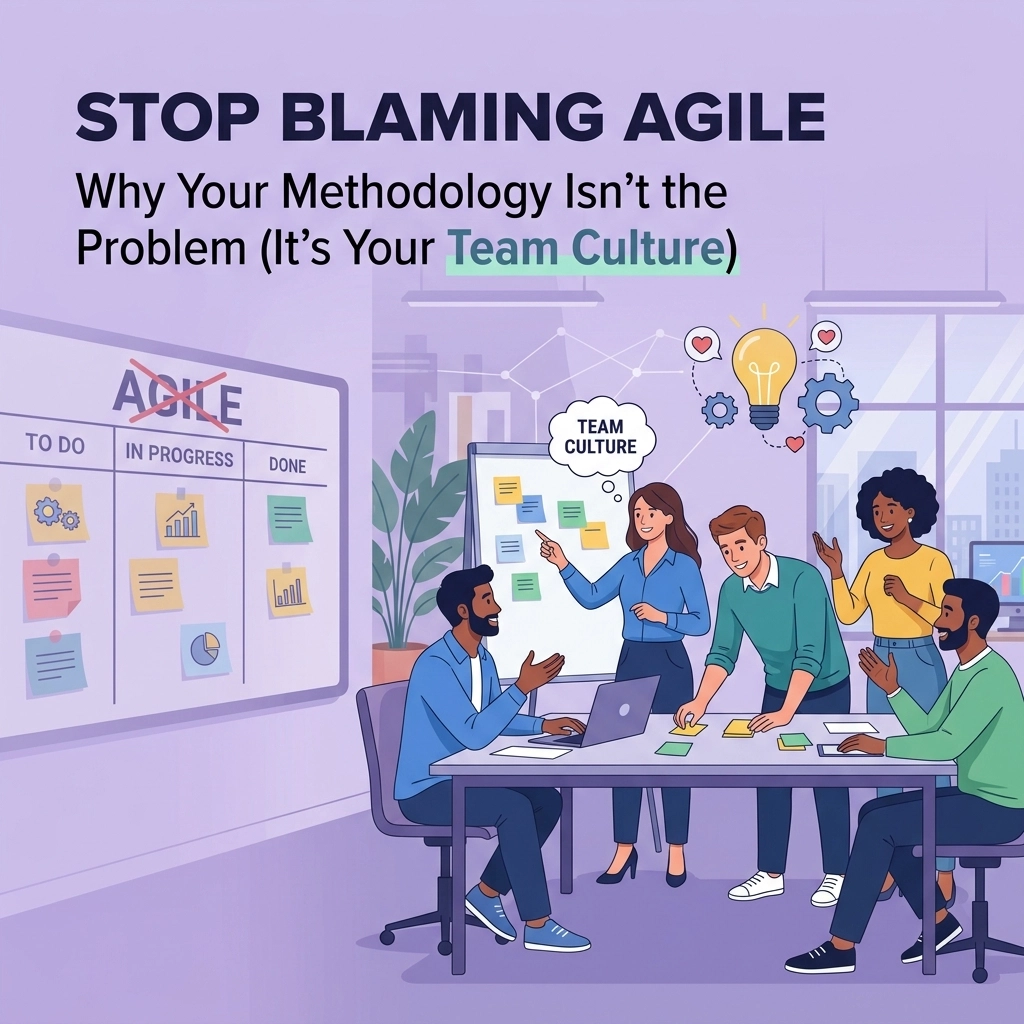
Stop Blaming Agile: Why Your Methodology Isn’t the Problem (It’s Your Team Culture)
I hear it all the time in my line of work. A frantic email arrives, or a Zoom call starts with a heavy sigh: “Penny, we switched to Agile six months ago, and honestly? Everything is a mess. The deadlines are still slipping, the team is burned out, and our daily stand-ups feel like an interrogation. I think Agile just doesn’t work for us.”
Whenever I hear this, I have to take a deep breath and offer a little reality check: sunny side up, of course. In a nutshell, if your Agile implementation is failing, it’s almost never the methodology’s fault. It’s not because Scrum is “too rigid” or Kanban is “too loose.”
The truth is much more personal: Your methodology isn’t the problem; your team culture is.
As we dive into the second part of our 6-topic series on the human element of IT, we need to address the elephant in the room. Agile is an amplifier. If you have a healthy, high-trust culture, Agile will make you move at the speed of light. But if you have a culture rooted in blame, fear, or silos, Agile will simply shine a bright, uncomfortable light on those dysfunctions and make them impossible to ignore.
Let’s stop blaming the framework and start looking at the people in the room.
The Digital Transformation Reality Check
In the world of IT consulting, we often see companies treat “Digital Transformation” like it’s a software update. You download “Agile 2.0,” install it over your existing processes, and wait for the performance boost.
But transformation isn’t about the tools you use; it’s about the people using them. You can rename your Project Managers to “Scrum Masters,” call your requirements “User Stories,” and trade your long meetings for “Sprints,” but if the underlying behavior doesn’t change, you’re just doing “Waterfall in disguise.”
I’ve seen organizations spend millions on consultants to implement the perfect Agile framework, only to end up with the same late projects and finger-pointing. Why? Because they forgot the “Human Element.” They focused on the process but ignored the people.
Agile requires transparency. It requires the courage to say, “I’m stuck,” or “This isn’t working,” without fear of being reprimanded. If your culture values “looking busy” over “being honest,” Agile will fail every single time. It’s not a magic wand; it’s a mirror. And sometimes, what we see in the mirror isn’t pretty.

The T.E.A.M. Methodology: The Secret Sauce
At Lurdez Consulting Group, we don’t just focus on the technical specs. We focus on relational excellence. We use a framework we call T.E.A.M.: Tenacious, Equable, Analytical, and Magnetic. When you apply these four traits to your Agile implementation, the methodology finally starts to work.
- Tenacious: Agile transitions are messy. You will fail. You will have sprints that end in disaster. Being Tenacious means you don’t quit and go back to the “old way” when things get tough. It means you are committed to the values of Agile, even when the process feels bumpy.
- Equable: This is critical. In a fast-paced environment, things go wrong. An Equable leader stays calm under pressure. They don’t react with “Who messed up?” instead, they ask, “How do we fix this together?” If you want a culture of trust, you have to be the person who keeps their cool when the server goes down.
- Analytical: Agile is built on data: velocity, burndown charts, cycle time. But you must use this data to learn, not to judge. An Analytical mindset looks at a slow sprint and asks what external blockers were in the way, rather than assuming the team was being lazy.
- Magnetic: Relationships are the glue of any project. A Magnetic leader builds rapport and makes people want to collaborate. You can’t force someone to be “Agile,” but you can inspire them to be part of a winning team.

Practical Integration Tips: Moving from Blame to Learning
So, how do you actually fix a toxic culture that’s killing your Agile dreams? It starts with small, intentional shifts in how you communicate.
- Kill the Interrogation Stand-up: If your daily stand-ups feel like a status report to a boss, you’re doing it wrong. Stand-ups are for the team to coordinate with each other. If I see a leader dominating the stand-up, I know we have a culture problem.
- Embrace the “Red” Status: In many cultures, showing a project status as “Red” is a career risk. So, people keep it “Green” until the very last second when it inevitably explodes. You need to reward people for raising red flags early. A “Red” status is a cry for help, not an admission of failure.
- Retrospectives Must Lead to Action: If you have the same complaints in every retrospective, the team will check out. I’ve seen this in “my little world” many times. People stop talking because they feel like no one is listening. Choose one: just one: thing to fix every sprint, and actually fix it.
- Stop Negotiating Estimates: When a developer says a task will take three days, and a stakeholder says, “Can you do it in one?” that’s not Agile; that’s bullying. Trust your experts. If you don’t trust their estimates, you don’t have a methodology problem: you have a trust problem.
The Leadership Mindset
Leadership is the ultimate bottleneck. I’ve met C-suite executives who say all the right things about “Agility” but then demand a fixed-price, fixed-scope, fixed-date contract for a complex software build. That’s like asking for a “sunny side up” egg but insisting the yolk be hard. It’s a contradiction.
As a leader, your behavior sets the ceiling for your team’s culture. Do you publicly share your own mistakes? Do you admit when you don’t have the answer? If you want a transparent team, you have to be a transparent leader.
I remember a client who was frustrated with their team’s “lack of ownership.” After spending a few days with them, I realized that every time someone took a risk and failed, they were publicly grilled in the next meeting. Of course they didn’t want ownership! They wanted safety. Until that leader changed their reaction to failure, no amount of Scrum training was going to help.

Building Your Adaptive PMO
In many traditional companies, the Project Management Office (PMO) acts as the “process police.” They are there to make sure every form is filled out and every box is checked. In a modern, human-centric environment, we need to shift toward an Adaptive PMO.
An Adaptive PMO doesn’t just track tasks; it removes friction. It looks at the T.E.A.M. dynamics and identifies where the culture is lagging. Instead of asking, “Why is this late?” the Adaptive PMO asks, “What can I take off your plate so you can finish this?”
This shift is essential for IT program and project management. We move from being administrators to being facilitators. We stop worrying about whether the Jira board is perfect and start worrying about whether the team is communicating effectively.
8 AI-Augmented PMO Services
While we focus on the human element, we can’t ignore the power of technology to support our culture. AI isn’t here to replace the Scrum Master; it’s here to augment them. Here are eight ways an AI-augmented PMO can help heal your team culture:
- Predictive Bottleneck Detection: AI can analyze workflow patterns and predict where a team will get stuck before it happens, allowing leaders to intervene with support rather than blame.
- Automated Meeting Summaries: By capturing the “why” behind decisions in stand-ups, AI ensures everyone is on the same page, reducing “wishy-washy” communication.
- Sentiment Analysis: Ethical AI tools can gauge the “vibe” of team communications, alerting leaders to burnout or rising tensions before they lead to turnover.
- Resource Load Balancing: AI can ensure no single person is carrying the entire load, promoting the “Equable” pillar of our T.E.A.M. methodology.
- Smart Backlog Grooming: AI can help prioritize tasks based on actual value, helping the team stay focused on outcomes rather than just output.
- Real-Time Risk Assessment: By scanning documentation and communications, AI can flag risks that humans might miss, encouraging early transparency.
- Skill-Gap Identification: AI can suggest training opportunities based on the project’s needs, helping team members grow and feel valued.
- Eliminating “Drudge Work”: By automating status reporting and data entry, AI frees up the team to focus on what they do best: solving problems and building relationships.

What’s Next
Agile is a beautiful thing when it’s powered by a healthy culture. It’s about people, trust, and the courage to adapt. If you’re struggling, I encourage you to take a step back from the charts and the ceremonies. Look at your team. Are they afraid? Are they connected? Do they trust you?
Fix the culture, and the methodology will take care of itself. Trust me, I see it happen every day.
Stay tuned for our next post in the series, where we’ll dive into The Art of the Difficult Conversation: Why Avoiding Conflict is Killing Your ROI. We’ll talk about how to navigate those “wishy-washy” moments and turn conflict into a catalyst for growth.
If you’re ready to stop the blame game and start building a high-performing IT team, let’s chat. You can reach out to us at Lurdez Consulting Group or check out our testimonials to see how we’ve helped others transform their team culture.