
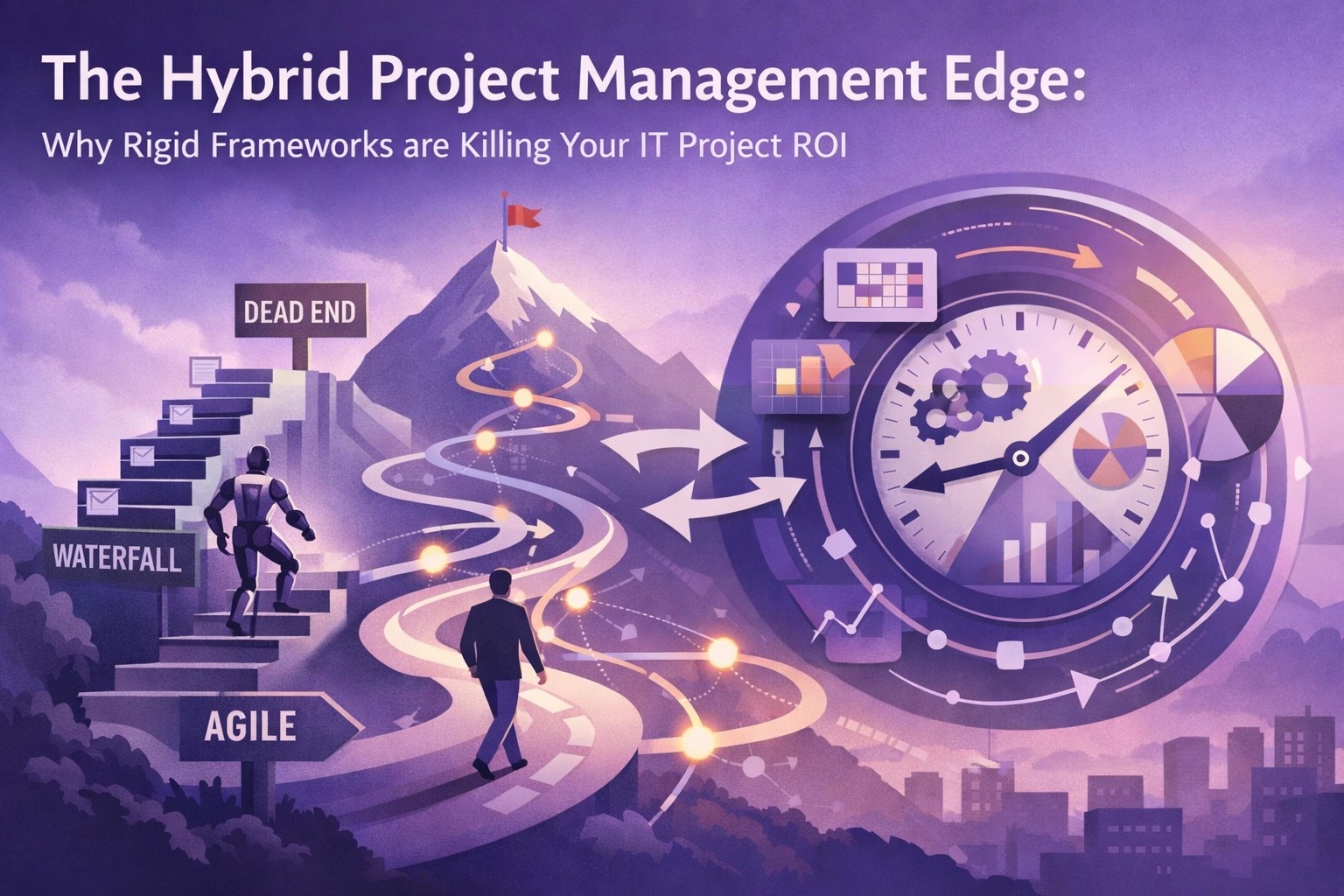
The Hybrid Project Management Edge: Why Rigid Frameworks are Killing Your IT Project ROI
I’ve seen it happen more times than I’d like to admit. A company invests hundreds of thousands, sometimes millions, into an IT project, only to watch it spiral into scope creep, missed deadlines, and frustrated stakeholders. And when we dig into what went wrong, the answer is almost always the same: they tried to force a one-size-fits-all framework onto a project that demanded flexibility.
Here’s the truth that most IT consulting firms won’t tell you: rigid adherence to any single project management methodology is quietly killing your ROI. Whether you’re a pure Agile zealot or a Waterfall purist, the moment you stop adapting to your project’s unique needs is the moment you start hemorrhaging time, money, and team morale.
Let me explain why hybrid project management methodology isn’t just a buzzword, it’s your competitive edge.
Don’t get me wrong, I love Agile. The iterative approach, the regular stakeholder feedback, the ability to pivot quickly when requirements change. It’s beautiful when it works.
But here’s what happens in the real world: teams interpret “Agile” as “we don’t need comprehensive planning.” Documentation becomes an afterthought. Governance goes out the window. And suddenly, you’re three sprints in with no clear roadmap, no budget controls, and stakeholders who have no idea where the project is actually headed.
I’ve walked into organizations where development teams were moving fast, really fast, but in completely different directions. Everyone was “being Agile,” but nobody could answer basic questions like “When will this be production-ready?” or “How does this align with our compliance requirements?”
Pure Agile struggles in complex IT environments because software projects need more than flexibility, they need structure for resource management, regulatory compliance, and long-term strategic alignment. Without that foundation, you’re not being nimble; you’re just improvising expensively.
On the flip side, I’ve consulted with organizations that worship at the altar of traditional project management. Every requirement meticulously documented. Every phase gate clearly defined. Gantt charts that would make your head spin.
And then reality hits.
A critical vendor changes their API. A stakeholder realizes mid-project that the requirements they signed off on six months ago don’t actually solve their business problem. A new security vulnerability emerges that requires immediate architectural changes.
Rigid Waterfall methodologies can’t accommodate the rapid changes and continuous feedback integral to modern software development. By the time you’ve gone through change request approvals and updated your project charter, your competitors have already shipped three iterations.
The result? Projects that deliver exactly what was planned, 18 months ago, but completely miss what the business actually needs today. That’s not success. That’s expensive failure with better documentation.
This is where hybrid project management methodology transforms IT project outcomes. And I’m not talking about some wishy-washy “do whatever feels right” approach. I’m talking about strategically combining the strengths of traditional and Agile methodologies based on your project’s specific characteristics.
Here’s what this actually looks like in practice:
Upfront Strategic Planning with Iterative Execution. We establish clear governance frameworks, comprehensive stakeholder analysis, and robust risk assessments, all the good stuff from traditional project management. But then we execute in iterative cycles that allow for rapid design, testing, and adjustment. You get the control you need for compliance and resource management without the rigidity that creates delays.
Documented Flexibility. Yes, we document everything. But our documentation evolves with the project. We maintain living roadmaps that stakeholders can actually use for decision-making, not dusty artifacts that become obsolete the moment they’re approved.
Responsive Risk Management. Traditional project management excels at identifying and assessing risks upfront. Agile excels at responding quickly when those risks materialize, or when new ones emerge. Hybrid approaches give you both: thorough risk planning combined with nimble risk response.
The data backs this up. Research shows that projects utilizing hybrid methodologies have higher success rates compared to those relying solely on traditional or agile methods. We’re talking about documented cases of 30% reduction in project delivery times while simultaneously improving quality metrics.
But here’s what the methodology frameworks miss, and this is critical: IT projects don’t fail because of bad frameworks. They fail because of broken relationships.
You can have the perfect hybrid methodology documented in a beautiful project charter, but if your development team doesn’t trust your business analysts, if your stakeholders feel steamrolled instead of heard, if your project managers are fighting fires instead of building alignment, you’re still going to fail.
This is where our approach to IT program and project management goes deeper. We call it relational excellence, and it’s the secret sauce that makes hybrid methodologies actually work in the real world.
Relational excellence means treating project management as a human discipline first and a technical discipline second. It means:
Building psychological safety so team members surface problems early instead of hiding them until they become crises.
Creating genuine stakeholder alignment through transparent communication, not just status reports.
Developing trust between technical and business teams so they collaborate instead of operate in silos.
Establishing feedback loops that people actually want to participate in because they see their input matters.
When you combine hybrid project management methodology with relational excellence, something powerful happens. Your team stops seeing methodology as bureaucracy to work around and starts seeing it as infrastructure that helps them succeed.
At Lurdez Consulting Group, we operationalize this through our T.E.A.M. methodology: Tenacious, Equable, Analytical, and Magnetic. Let me break down how this transforms hybrid project management from theory into results:
Tenacious: We don’t give up when the project hits inevitable obstacles. But tenacity doesn’t mean stubbornly sticking to a plan that isn’t working. It means persistently finding the right approach, whether that’s adjusting scope, renegotiating timelines, or pivoting methodology components based on what the project actually needs.
Equable: We maintain consistency and fairness in how we apply methodology. Every stakeholder gets transparency. Every team member gets clarity on expectations. No hidden agendas, no favoritism, no surprises. This creates the trust foundation that makes hybrid approaches work.
Analytical: We make decisions based on data, not dogma. If Agile sprint metrics show we’re accumulating technical debt, we introduce more rigorous design reviews. If stakeholder satisfaction scores drop, we increase communication cadence. The methodology serves the project, not the other way around.
Magnetic: We create project environments that attract talent and engagement. When your best developers and business analysts want to work on your projects because they trust the process and each other, that’s when hybrid methodologies deliver their full potential.
If you’re a business owner or IT leader reading this, here’s what you need to understand: the question isn’t whether to use Agile or Waterfall. The question is whether you have the expertise to strategically combine methodology components based on your project’s unique context.
Do you have stakeholders who need predictable roadmaps for budgeting and strategic planning? That requires traditional planning elements. Do you have rapidly evolving technical requirements that need frequent validation? That requires Agile execution elements. Do you have compliance requirements that demand comprehensive documentation? That requires traditional governance. Do you have competitive pressure demanding fast time-to-market? That requires Agile delivery cycles.
Most complex IT projects have all of these requirements simultaneously. Rigid frameworks force you to choose. Hybrid approaches let you address them all.
Let’s talk numbers for a moment, because this isn’t just about methodology philosophy, it’s about your bottom line.
When projects fail or significantly underperform, the costs compound:
Direct costs: wasted development hours, unused software licenses, shelved infrastructure investments.
Opportunity costs: missed market windows, delayed digital transformation, competitive disadvantage.
Organizational costs: team burnout, loss of stakeholder trust, damaged IT credibility.
I’ve seen organizations lose seven-figure investments because they insisted on pure Agile for a highly regulated system that needed comprehensive upfront design. I’ve seen others blow through budgets by 200% because their Waterfall approach couldn’t adapt when business priorities shifted mid-project.
The ROI impact of choosing the wrong methodology, or applying any methodology too rigidly, is massive. And it’s completely preventable with the right approach to IT project management consulting.
If your IT projects consistently run over budget, miss deadlines, or deliver solutions that don’t quite meet business needs, the problem probably isn’t your team. It’s your approach to project management methodology.
The good news? This is fixable. Hybrid project management methodology combined with relational excellence and the T.E.A.M. approach creates a framework that adapts to your projects instead of forcing your projects to adapt to arbitrary methodology constraints.
At Lurdez Consulting Group, we’ve spent years refining this approach across diverse IT projects, from data center migrations to enterprise software implementations to digital transformation programs. We’ve learned what works, what doesn’t, and how to quickly identify which methodology components your specific project needs to succeed.
Your IT projects are too important and too expensive to leave to rigid frameworks that can’t adapt to reality. Let’s talk about how hybrid project management methodology can transform your IT project outcomes.
Ready to stop leaving ROI on the table? Reach out to us and let’s discuss how we can bring relational excellence and strategic methodology selection to your next critical IT project.