
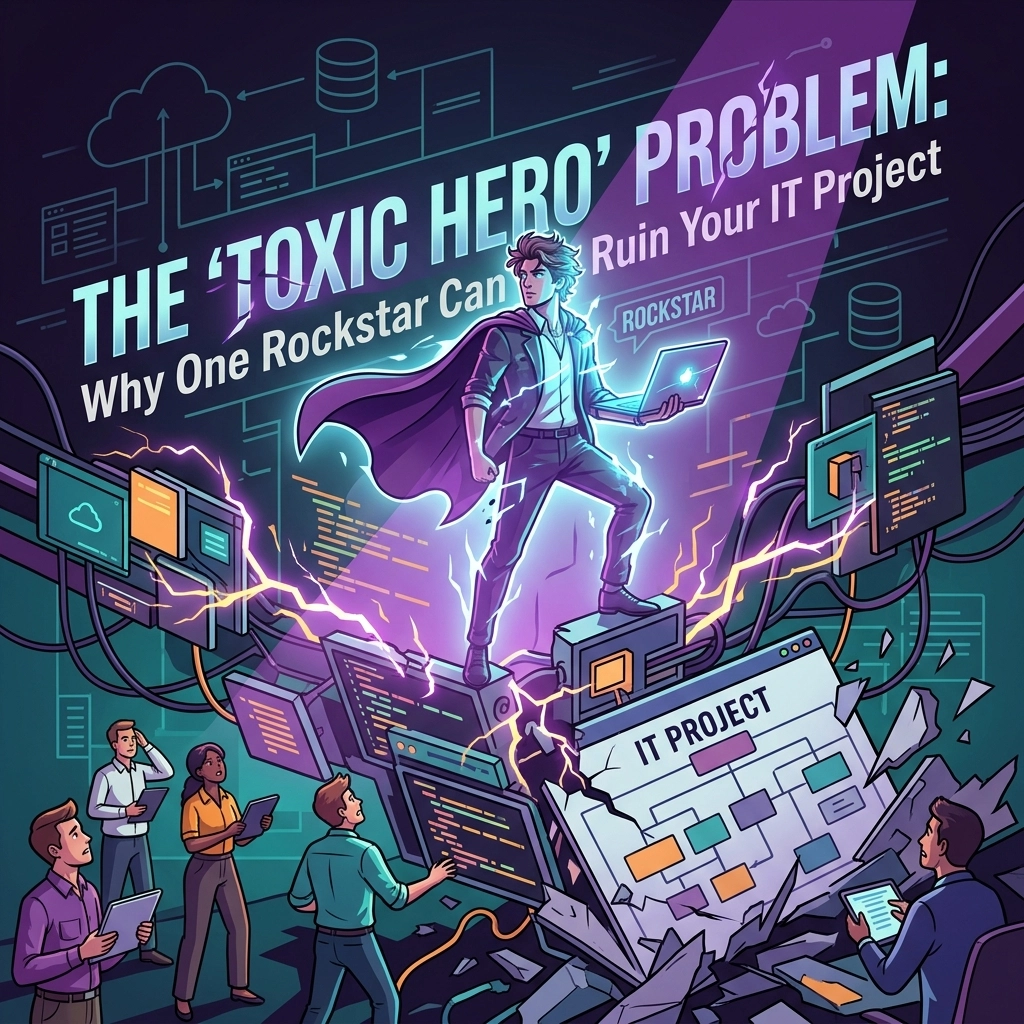
The ‘Toxic Hero’ Problem: Why One Rockstar Can Ruin Your IT Project
I’ve been in the IT consulting world for a long time, and if there is one thing I’ve learned, it’s that a project’s success is rarely about the code. It’s about the people. I get emails and messages all the time from leaders who are frustrated because their high-stakes digital transformation is stalling, and usually, they point to the tech. But when I dig a little deeper, into what I call “my little world” of relational excellence, the problem is often sitting right in the middle of the conference room.
We call them the “Rockstar.”
They are the developer who stays until 3:00 AM to fix a critical bug. They are the architect who knows the legacy system better than anyone else. On paper, they are indispensable. But in reality? They are a “Toxic Hero.” They save the day at midnight, but by 9:00 AM the next morning, they’ve managed to alienate the entire QA team, belittle the junior devs, and make the Project Manager want to hide under their desk.
In a nutshell, they are the most dangerous person on your team.
The Digital Transformation Reality Check
It’s easy to fall into the trap of thinking that technical brilliance outweighs a bad attitude. When you’re staring down a multi-million dollar data center migration or a complex AI integration, you feel like you need that person. You tell yourself, “Sure, they’re difficult, but we can’t do this without them.”
This is what I call the “Toxic Hero Trap.”
Truthfully, when you have a high-performer with a bad attitude, you aren’t just dealing with a personality clash; you’re dealing with a massive risk to your ROI. These “heroes” often create what we call a “single point of failure.” They hoard knowledge because it makes them powerful. They refuse to document their work because they want to be the only ones who can fix it.
The result? The rest of the team stops trying. Morale plummets. Why bother suggesting an idea if the “Rockstar” is just going to shoot it down or call it “stupid”? Eventually, your best people leave, not because they hate the work, but because they can’t stand the environment. That’s how a single person ruins a project. It’s not a technical failure; it’s a cultural one.

The T.E.A.M. Methodology: Reclaiming Relational Excellence
At Lurdez Consulting Group, we don’t just look at schedules and budgets. We look at the “human element.” To combat the Toxic Hero problem, we use our proprietary T.E.A.M. methodology: Tenacious, Equable, Analytical, and Magnetic.
When you look at a Toxic Hero through this lens, you see exactly where the wheels are falling off:
- Tenacious: The Toxic Hero usually has this in spades. They are determined to solve the problem (mostly so they can take the credit).
- Equable: This is where they fail. An Equable leader stays calm under pressure and treats others with respect, regardless of the stress level. The Toxic Hero is the opposite: they use stress as an excuse to be “wishy-washy” with their support or outright aggressive.
- Analytical: They are often highly analytical, but they use their data as a weapon rather than a tool for collaboration.
- Magnetic: This is the big one. A Magnetic leader draws people in and makes them want to work harder. A Toxic Hero is a repellant. They push people away, creating silos that stifle innovation.
By applying the T.E.A.M. framework, we can identify that while this person has the “T” and the “A,” their lack of “E” and “M” is actually costing the company more than their technical skills are worth.

Practical Integration Tips: How to Handle the “Rockstar”
So, what do you do if you realized you have a Toxic Hero on your hands right now? TGIF hasn’t arrived yet, and you have a project to deliver. You can’t just fire them on a whim, but you can’t let the status quo continue. Here is how you integrate real change:
- Separate Performance from Behavior: In your next one-on-one, don’t talk about their code. Talk about their impact on the team. Use clear, non-negotiable language. “Your technical output is stellar, but your communication style is hurting our progress.”
- Enforce Documentation: Stop the knowledge hoarding. Make it a requirement that for every hour of work, there is a corresponding “parking lot” of documentation that someone else can understand.
- Rotate Tasks: Don’t let the “Hero” always save the day. Intentionally give high-visibility tasks to other team members and have the “Rockstar” act as a mentor (if they can handle it) or a peer reviewer.
- The “No-Jerks” Policy: It sounds simple, but it has to come from the top. If the C-suite tolerates bad behavior because of “results,” the rest of the team will never feel safe.
The Leadership Mindset
Leadership in IT project management isn’t about being the smartest person in the room. It’s about creating a room where everyone can be their smartest self. I reserve most of my day for talking to people, listening to the “undercurrents” of a project, and ensuring that our relational excellence is as high as our technical standards.
If you are a leader, you must have the courage to address the “Toxic Hero.” It’s uncomfortable. It might even be scary if you think the project will fail without them. But research: and my own experience: shows that once a toxic element is removed or corrected, the rest of the team steps up in ways you never expected. Productivity goes up because the “fear factor” is gone.
Building Your Adaptive PMO
A modern, adaptive PMO shouldn’t just be a “reporting engine.” It should be the heartbeat of the organization. When we help companies build or refine their PMOs, we build in “health checks” that aren’t just about milestones. We ask:
- Is the team communicating openly?
- Are we seeing a high turnover in specific departments?
- Is knowledge being shared or hoarded?
By focusing on these relational metrics, you create a system that is resilient. You don’t need a “Hero” to save a project when the entire team is empowered to succeed together.
8 AI-Augmented PMO Services
Even though we are talking about the “human element,” we can’t ignore how technology helps us manage these human risks. At Lurdez Consulting Group, we leverage AI to ensure that no single person becomes a “Toxic Hero” by accident. Here are 8 ways we use AI-augmented services to keep projects on track:
- Sentiment Analysis: Using AI to analyze team communication (Slack, emails, Jira comments) to identify burnout or rising toxicity before it explodes.
- Automated Documentation: AI tools that “watch” code development or project updates and generate documentation, preventing knowledge hoarding.
- Resource Leveling: AI that identifies when one person is doing 80% of the heavy lifting, allowing us to redistribute the load.
- Predictive Conflict Modeling: Identifying patterns in past project failures to predict when team dynamics might sour.
- Skill-Gap Identification: Automatically finding who else on the team has the skills to take over a “Hero’s” task, ensuring redundancy.
- Bias Detection in Reviews: Ensuring that performance reviews are based on data and T.E.A.M. metrics, not just the “loudest” voice in the room.
- Real-Time Feedback Loops: AI-driven surveys that allow team members to report issues anonymously and instantly.
- Knowledge Graphs: Mapping out where all project information lives so that if a “Rockstar” leaves, the project doesn’t die with them.
What’s Next
I hope this gives you a fresh perspective on those “Rockstars” in your office. Remember, a high-performer is only an asset if they aren’t destroying the people around them. True it-leadership is about fostering a culture where everyone can shine.
Next week, we’re going to tackle another uncomfortable truth in our industry. We’re diving into the world of deadlines and estimates with: Why Your Project Schedule is a Lie (and what to do when your team is too scared to tell you the truth).